Baby L said my name this past weekend. "Mom mom mom mom." It was unmistakable. For months he's insisted on calling both of his parents "Dad," which may have been a baby protest of normative gender roles or something. But this weekend, he finally said "Mom."
His language--both verbal and non-verbal, both receptive and expressive--is blossoming, and it is exciting to watch this miracle unfold. He points to what he wants and sometimes pairs it with words (to go outside, for instance, he points to the back door and says "side"). He's also mastered saying when he wants more of something or when he's done. Without prompting, he signs "more" when he wants more, and when he's done, he puts his hands in the air and says "dah, dah, dah" for "done." And every time he communicates with me, I get choked up. It's so amazing, so amazing.
Yet the beauty can be bittersweet. The other night, Beh was taking a shower, and I stepped in the room to see how he was doing.
"Do you want more shower, or are you all done?" I asked as L pulled himself up to the side of the tub, interested as always in what his brother was doing.
Beh had a perplexed look on his face, like he knew I was asking something and wanted a response from him, but he had no clue how to give me what I sought.
"Do you want more shower," I said as I signed more, "or are you all done," I said, again with the sign paired with my words.
Beh was still completely lost.
"Do you want shower on or shower off?" I thought different words might help him find his voice. I said it again.
"Shower off," said Beh. I really didn't know if he said it to communicate, or if he was just echoing me, but I took it as communication.
I leaned down to move L's hands from the edge of the tub so that Beh could open the shower door. L, this tiny boy who loves his big brother so much that he wants to always be with him and do whatever he is doing, gave me a bit of a fight. He didn't want to move even one inch away from Beh. As I gently moved him, I looked at him, and my heart broke a little bit. Here was this fourteen-month old who could do something that his nine-year-old brother has to fight--HARD--to do every day. Concepts like "more" and "done" are simultaneously so simple that a baby can master them and so challenging that a fourth grader has to give all the fight he has to grasp them. My heart hurt for Beh, that he had to fight so hard to grasp something so many of us take for granted.
I turned the water off and Beh giggled as he burrowed himself into his towel. L bounced up and down, squealing in glee at the sound of his brother's laugh. I looked at them again, and this time, instead of feeling the bittersweetness of L being able to express things that Beh can't, I felt hope. L doesn't look at Beh and see autism; he doesn't look at him and see limitations. He sees someone he wants to be just like. There's an ineffable beauty in such unconditional love. It is a love dependent in no way on words; it is a love that I know will follow Beh through his lifetime. When he can't find the words, his little brother will be there to help him find his voice. L sharing the language he's building be a voice for Nick . . . I can't imagine a more beautiful gift a brother could give.
Showing posts with label language. Show all posts
Showing posts with label language. Show all posts
Thursday, October 9, 2014

Monday, November 1, 2010
Airplane Love

It's funny how the little things can change the world for a kid, especially a kid with autism.
Nick has kept to the same obsessions for most of his life. Letters. Numbers. Street signs. Trains. Cranes. He'd build and create the most elaborate of structures, but they were always based on the same small cluster of obsessions. He'd write words on the walls with wiki sticks, write lines of numbers up to 100 with chalk, build trains and cranes and street signs with Legos and waffle blocks and Brio sets.
And then, last month, something new came into his world.
It wasn't a planned gift at all, more of a "here's some kid stuff I have lying around--do you think your kids would want it" sort of thing. But the haphazard re-gifting reshaped Nick's reality.
It was an inexpensive glider, the kind where the wings slide into a slit on the body. I gave it to Noah, thinking he'd enjoy using a rubber band to launch it . . . but Nick was drawn to it. Intensely drawn to it.
All of the sudden there was a burst of language tied to the airplane. He'd ask to go outside because that was where the plane was, and once outside he'd say "airpwane, airpwane" until I retrieved it. He couldn't figure out how to make the plane fly, so he'd bring it to me to throw. "Ready, steady, fly!" he'd say when he wanted to see it soar. Soon he added "high in the sky."
The airplane got dirty and lost its nose; it got covered in red when Nick had a nosebleed yet didn't want to relinquish his toy. Eventually the airplane died, never made to withstand the love of a five-year-old boy.
But Nick wasn't deterred. Yesterday he took his Brio blocks outside . . . and built his own airplane. Throughout the day he added detail after detail, making the plane come alive.
This morning, after Noah went off to school, Nick asked to go outside. It was one of those amazing November mornings that you get only in Arizona--the air was alive with the warmth of spring, ignoring everything the calendar had to say. Nick and I played in the sun, taking turns flying the plane. I'd run around, flying the plane throughout the yard, up and down, dip and turn, while Nick chased after me, laughing. "Airpwane fly, high in the sky!" he'd say as the plane pirouetted in the air.
Soon it was time to come inside and prepare for kindergarten. Nick brought his airplane inside with him, and when it was time to take a bath, the airplane joined him. When it was time to eat a snack, the airplane was on the table next to his plate. When it was time to go to the bus stop, the airplane came along, too.
It's probably the only Brio block airplane to ever follow a boy through an afternoon of kindergarten.
Others of us might have been deterred when our original airplane died. Having invested so much love into it, we might have lost ourselves in tears or tantrums (for there are adult versions of those). Nick inspires me: he found a new love, loved it with all his heart . . . and when he lost what he loved so much, he made his own airplane, one much more beautiful than anything anyone could have ever purchased, one so much more amazing than anyone could have imagined.
The beauty of loss--there is so much to gain from it.
Nick has kept to the same obsessions for most of his life. Letters. Numbers. Street signs. Trains. Cranes. He'd build and create the most elaborate of structures, but they were always based on the same small cluster of obsessions. He'd write words on the walls with wiki sticks, write lines of numbers up to 100 with chalk, build trains and cranes and street signs with Legos and waffle blocks and Brio sets.
And then, last month, something new came into his world.
It wasn't a planned gift at all, more of a "here's some kid stuff I have lying around--do you think your kids would want it" sort of thing. But the haphazard re-gifting reshaped Nick's reality.
It was an inexpensive glider, the kind where the wings slide into a slit on the body. I gave it to Noah, thinking he'd enjoy using a rubber band to launch it . . . but Nick was drawn to it. Intensely drawn to it.
All of the sudden there was a burst of language tied to the airplane. He'd ask to go outside because that was where the plane was, and once outside he'd say "airpwane, airpwane" until I retrieved it. He couldn't figure out how to make the plane fly, so he'd bring it to me to throw. "Ready, steady, fly!" he'd say when he wanted to see it soar. Soon he added "high in the sky."
The airplane got dirty and lost its nose; it got covered in red when Nick had a nosebleed yet didn't want to relinquish his toy. Eventually the airplane died, never made to withstand the love of a five-year-old boy.
But Nick wasn't deterred. Yesterday he took his Brio blocks outside . . . and built his own airplane. Throughout the day he added detail after detail, making the plane come alive.
This morning, after Noah went off to school, Nick asked to go outside. It was one of those amazing November mornings that you get only in Arizona--the air was alive with the warmth of spring, ignoring everything the calendar had to say. Nick and I played in the sun, taking turns flying the plane. I'd run around, flying the plane throughout the yard, up and down, dip and turn, while Nick chased after me, laughing. "Airpwane fly, high in the sky!" he'd say as the plane pirouetted in the air.
Soon it was time to come inside and prepare for kindergarten. Nick brought his airplane inside with him, and when it was time to take a bath, the airplane joined him. When it was time to eat a snack, the airplane was on the table next to his plate. When it was time to go to the bus stop, the airplane came along, too.
It's probably the only Brio block airplane to ever follow a boy through an afternoon of kindergarten.
Others of us might have been deterred when our original airplane died. Having invested so much love into it, we might have lost ourselves in tears or tantrums (for there are adult versions of those). Nick inspires me: he found a new love, loved it with all his heart . . . and when he lost what he loved so much, he made his own airplane, one much more beautiful than anything anyone could have ever purchased, one so much more amazing than anyone could have imagined.
The beauty of loss--there is so much to gain from it.
Friday, January 29, 2010
So typical; so beautiful
Nick and I were early. Noah's after-school science club meeting was still in session, so Nick and I made our way over to the playground. He climbed up on the play structure, then ran back and forth across the bridge in joy.
A couple of little girls came over and climbed up the steps to the slide then slipped down.
Nick watched them from the bridge and laughed. "Slide down!" he said and went over to join the girls in their play. The three of them slid down the slide, time and time again, and sometimes Nick would get so excited about sliding that sometimes he forgot to wait, sliding into the girl in front of him, laughing all the way.
*******************
Such an unnotable, typical day at the playground for just about any parent. Any parent, that is, except for an autism mom. I watched my child play and wanted to call every single person in my cell phone to scream out my excitement.
You see, six months ago, Nick would not have even noticed the girls. Six months ago, Nick would not have been able to say "slide down." Six months ago, Nick would have never gone over to other kids and joined them in their play.
It's the most average, typical things that are the most precious; they are the things I celebrate, the things that make me cry.
Monday, January 4, 2010
Putting the key in the lock

Our world is based on words. They are the way we share our feelings and fears, our hopes and needs. Whether they are signed, written, or spoken, they are the way we communicate with one another.
But imagine that you never understood that words were communicative. You spent your life around them, and maybe even used them to label things in your environment, but you never understood that they could be used to convey your wants and emotions to others.
Imagine that, and you know what life has been like for Nick.
Nick is almost five years old, yet he'd never made the developmental leap that infants master: understanding that the sounds one makes are a way to influence those in the world around him.
The irony isn't lost on me; here I am, the writing teacher who believes in the ultimate rhetorical power of words to shape and change the world, and my own son is oblivious to the power I preach.
But Nick got it today.
It started on Thursday when Jerrud was working with Nick. Nick usually uses PECS cards to communicate, but when Nick was wanting chips, Jerrud was pushing him to say the word. "Chhhh-ip," he modeled for Nick.
For some reason, Nick decided to go ahead and copy Jerrud. And magically he was rewarded with the chip he wanted and lots of praise.
Nick didn't think that was so bad, so he played along again. And got his chip.
He started putting the pieces together: "I say this group of phonemes, and someone gives me a chip. Cool."
Friday, Saturday, and Sunday we practiced the word "chip." Sometimes I'd manipulate the situation, getting chips and then asking him what he wanted as he drooled over my stash (actually, that's also how I taught him to use his first PEC, which was a chips card). Other times he'd request chips all on his own, bringing me his chips PECS card but saying the word when he made the exchange.
Today, though, Nick learned to transfer the skill he learned with the word chip to other contexts.
First it was "pretzel." But the cutest imaginable version of the word *ever*. It was more like two words, actually: "Pweh. Zil!" After some frustrations, he deftly navigated through the linguistic landscape, saying "chip" when that was what he wanted and "pretzel" when he wanted something different.
Of course, salty snacks make a child thirsty, so how about some juice? I filled his cup with apple juice . . . and he said the word when he wanted Jerrud to give him the cup! Awesome!
So we spent the early afternoon cycling through these three words when I got curious. What else would he say?
I brought in a 16-ounce bottle of Coke, which he loves. I gave him a choice between the apple juice and the Coke. "Nick, what do you want?"
"Co," he answered.
Sweet!
I hunted down a bag of M & Ms, and my child asked for the candies, over and over and over again, by saying "M" (this worked for me; I mean, there's just one "m" on the candy so why should I make him say two of 'em?).
Next I brought him some cookies, and again, success.
Nick has had some language since he was one year old, back when he'd read the letters and numbers off the license plates of cars. He's babbled in his own language, and he's labeled things in his environment as he attends to them. But his words only reflected context. Today, though, my son became a rhetor and learned about audience and purpose. He realized that he could guide his audience (me) to a specific purpose (to get him stuff he wanted).
How many times I have drawn that tired old triangle on the board in my writing classes, telling my students how important it was that their message take into account audience, context, and purpose? I preached it for years . . . but I never really understood its significance until today, when my child finally put all three together and opened a door to a new world.
Saturday, December 12, 2009
Sticks and Stones
Words are nothing, these tiny units of sound. Except, they are everything. They reflect and create our realities. They include and exclude people.
Some have said that disability rights is the last great civil rights battle to be waged. Over the decades we've seen women and people of color and people of a variety of sexual orientations make progress in the civil rights arena. Those gains have been reflected in the language our culture deems acceptable. In a staff meeting, it would not be acceptable to call a female colleague a bitch, or refer to an African American colleague with the n-word, or to call a gay colleague a fag. Yes, such horrible language can still be heard behind closed doors--a sign that these groups are still marginalized and that we need to continue to work for equality--but in our public personas, we know such language is not okay and so we don't use it.
I wish that we had such critical awareness of the language we use to address people with disabilities. Because I have been in staff meetings where colleagues used the word 'retards,' and no one seems to cringe the way they would have if someone had used a racialized term or a gendered term.
My sons have autism, something you certainly know if you've read this blog even once. They are not typical, and yet I do not see them as disabled. They are both incredibly abled, each in his own way. Nick is a gifted builder and mathematician. Noah is a gifted linguist and scientist. They are incredibly abled.
And yet they are different. The icon of the autism community has been the puzzle piece, as if people with autism are a bunch of puzzle pieces that need to be put back together (or fixed) in order for them to make sense. My sons aren't puzzles; they are complete and full human beings . . . the rest of the world just, far too often, fails to stop a moment to look at them and see who they truly are.
So often others focus so much on how different my sons are that they fail to see how similar they are to the rest of us--they are human beings with emotions, desires, and hurts.
Perhaps it's that difficulty of seeing the similarities between "us" and "them" that makes it okay in our culture to use disparaging language to describe people who are differently abled. I mean, "we" don't see "them" as like "us," as human, so we can't fathom that "they" would have emotions and desires and hurts. Sticks and stones can't hurt them.
It's not just college staff meetings where that language pops up. It pops up in elementary schools, too. There's a girl at Noah's school who has picked up on his differences and calls him "freak."
Think about that word. Does it shock you? Unnerve you? Maybe a little?
But not as much as if someone had called him the n-word, huh.
We still have a cultural tolerance for disparaging labels applied to people who are differently abled.
Here's the thing, though. The words hurt. Even if they are culturally acceptable, they still make my son cry. They reflect and create our realities, making a world that makes it okay to categorize others. They include and exclude people, cementing the categories of "us" and "them." They focus on what makes someone different rather than the so many things we all have in common.
We need to be conscious of our language. Disparaging language is not okay. And I'll fight to make sure that someday words like 'retard' and 'freak' will someday become as unacceptable as racial slurs.
Saturday, July 18, 2009
Kitty White
I spend most of my moments keenly aware of how lucky we are. I’m reminded time and time again that things could be a lot worse for Nick. He could have violent tantrums multiple times a day. He could pound his head against the wall just to stim on the blood pouring from his forehead. I know that things could be a lot worse.
But lately I've been watching some things unravel for my little boy. When we started seriously implementing biomedical interventions in December, Nick made tons of progress. Tons. His eye contact improved, his stims decreased, his sleep patterns normalized, and his chronic diahhrea healed. And then it seemed the progress decided to back pedal. Nick's stims are steadily increasing again (so much so that I lovingly gave him the nickname of Super Stim). His sleep patterns . . . well, I guess I can't use the word "patterns" because there is no pattern at all anymore--he's as likely to be awake at 4 AM as 4 PM. His stomach--that's the worst part. The chronic diahhrea has returned; he must feel miserable.
Last night I was tucking him in for about the tenth time because he just couldn't get settled enough to fall asleep. He'd look at a book, then stim on his hands (I finally figured out that he's imitating train signals with his arms--I think that's kinda cool, actually), then he'd get up out of his bed. I finally pulled out the lotion and rubbed his feet while he stimmed, giving him the deep pressure he loves. I rubbed and rubbed . . . and cried. I was doing everything I knew how to do to make him feel better--all the therapies, all the doctors, all the vitamins. I felt like there had to be some way to make him feel better, because I had seen his health improve so much just a few months ago, but I had no clue what it was. And so just I rubbed my son's feet and talked to him.
"Mommy loves you so much, Nick."
"I miss you."
Nick was right there next to me, his growing feet in my hands, but I still missed him. I missed hearing him tell me about his day. I missed hearing him tell me about the thing going through his head that made him laugh so hard. I missed hearing him share his hurts with me so that I could comfort him. And just because I've never actually heard him say any of those things doesn't make the missing any less real.
I wiped a tear and started rubbing the lotion on his hands, wrists, and arms. And he started one of his verbal stims, one that I'd heard before. "Ki-dee-why," he said. Time and again.
But here's the thing: his pronunciation got clearer each time. It began to sound like "Kitty Why." And then . . . then I heard it.
"Kitty White. Kitty White."
I said it back to him and he smiled that content Nick smile that creeps across his face when he realizes someone gets him. "Kitty White," he said, eyes locked onto my face, and I said the phrase back to him.
Then I ran out of the room. To find his Kitty White.
I scooped Mitty up from her peaceful sleep and plopped her down on Nick's bed. "Kitty White," he said and laughed. "Meaaaaa-ow!"
I left Nick with his Kitty White . . . and, miracle of miracles, the restless boy found his sleep.
That wise little boy. Nick had done more than say "Kitty White." He'd answered me. He let me into that world that I'd been missing, told me that he'd been laying there thinking about his cat. That calm little smile that had crept across his lips winked at me. "See, Mom. I'm right here," it said--nothing to miss.
Friday, May 15, 2009
LANGUAGE!
Today Nick and I were sitting on the living room floor, playing with this:
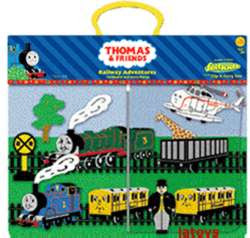
He started to pick up the pieces, one by one, to add to the felt board. The first one he picked up was Harold the Helicopter, and as he set Harold in the sky I said, "Harold!" (you know, in that happy, exaggerated, speech therapist kind of voice). Next he picked up the giraffe and set it in the sky opposite Harold, because of course giraffes belong in the sky. But when he placed that giraffe, he did the most amazing thing: he said "giraffe." Or an approximation of it. Holy cow.
Then he grabbed the tree, put it in the sky between the giraffe and Harold, and said "twee." I cheered. He touched the tree and said "twee" again. Then he did it again, and again.
Holy cow!
I'm always giving verbal labels to the objects that matter most to Nick, pounding the words into him. But giraffe? Tree? I haven't really focused on those, well, at all. It's stunning that he pulled those out. Stunning.
We continued to play and he said "Thomas," a word he's had for awhile because that silly train is his world, and then he pulled out yet another new word, "tracks."
Three new words in less than five minutes.
That's just freakin' huge.

He started to pick up the pieces, one by one, to add to the felt board. The first one he picked up was Harold the Helicopter, and as he set Harold in the sky I said, "Harold!" (you know, in that happy, exaggerated, speech therapist kind of voice). Next he picked up the giraffe and set it in the sky opposite Harold, because of course giraffes belong in the sky. But when he placed that giraffe, he did the most amazing thing: he said "giraffe." Or an approximation of it. Holy cow.
Then he grabbed the tree, put it in the sky between the giraffe and Harold, and said "twee." I cheered. He touched the tree and said "twee" again. Then he did it again, and again.
Holy cow!
I'm always giving verbal labels to the objects that matter most to Nick, pounding the words into him. But giraffe? Tree? I haven't really focused on those, well, at all. It's stunning that he pulled those out. Stunning.
We continued to play and he said "Thomas," a word he's had for awhile because that silly train is his world, and then he pulled out yet another new word, "tracks."
Three new words in less than five minutes.
That's just freakin' huge.
Subscribe to:
Posts (Atom)